What Pre-Season College Basketball Shows About Team Development
Pre-season college basketball shows all four stages of team development in a few games. Here is how forming, storming, norming and performing show up at work, and what managers can do at each stage.

Sarah Katherine Schmidt
November 8, 2026
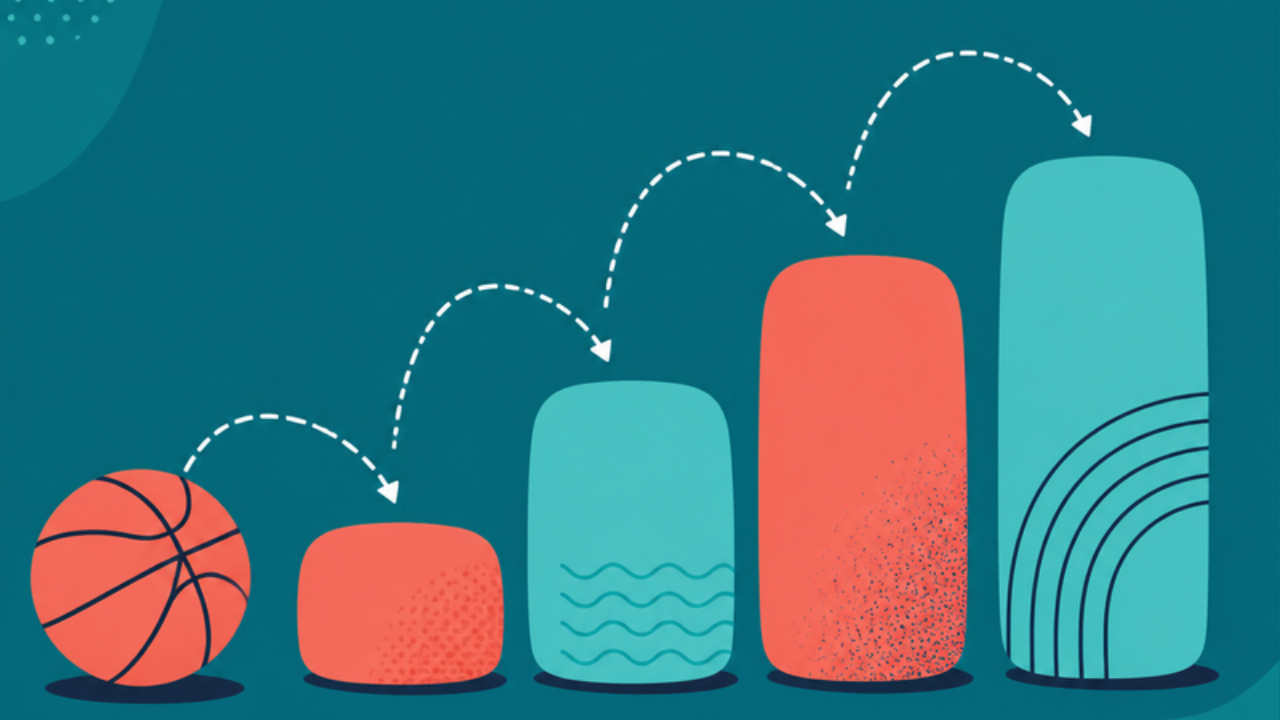
Teams learning to play together
I love pre-season college basketball. You get to see the teams just as they're trying to find their rhythm and learn how to communicate with one another. There are hits, misses, and moments where no one is clear on the direction or the play.
It's also a clear picture of how teams develop at work. Bruce Tuckman described four stages that groups tend to move through: forming, storming, norming, and performing. A November game shows all four in one place, sometimes within a single quarter.
Forming and storming
Forming is the early games. Players are polite, still learning each other's tendencies, and not sure who takes the last shot. At work this is the first few weeks of a new team or a new project. People are friendly and cautious, and they wait for someone to tell them how things run.
Storming is where the mistakes show up. A pass goes to a spot where the teammate wasn't, two people go for the same rebound, and someone is visibly frustrated. In an organization it looks like missed handoffs, duplicated effort, and meetings where people disagree without saying so.
It is uncomfortable to watch, and it is also useful. Each miss tells the team something specific about what it needs from each person: who wants the ball where, who needs a clearer signal, and which decisions nobody owns yet.
Norming and performing
Norming starts when the team agrees on how it plays. Roles get clearer, players learn where each teammate wants the ball, and they start talking on defense. For a work team this is the point where people settle who decides what, how a disagreement gets raised, and what "done" means.
Performing is when the team stops thinking about the system and plays. The handoffs happen without a conversation about them, and people spend their attention on the problem in front of them. Getting there takes repetition, and nobody skips the earlier stages to reach it.
Expect the early mistakes
Nobody expects a team to look like a March team in November. Coaches plan for the early mistakes and use them as film to learn from.
At work we often expect a new team, or a team with new members, to perform right away. When the storming phase arrives, we read it as a sign that something is broken, when it is usually a sign that people are working out how to operate together.
The stages also restart. A new member, a new goal, or a reorg puts a team back near the beginning, even if the same people have worked together for years. A team that was performing last quarter may need to go back through forming and storming on the new work.
What managers can do
A few things help a team move through the stages with less friction:
- Name the stage out loud. "We're new together and still figuring out handoffs" is a useful thing for a team to hear, and it takes some of the pressure off the early misses.
- Review the misses soon after they happen, the way a coach goes through film. Keep the focus on the play and what the team can change, not on the person who made it.
- Make roles and decision rights explicit early, so fewer moments depend on guessing who owns what.
- Check in again when the team changes. A new member or a new goal is a reason to revisit roles and how the team communicates.
Which stage is your team in right now, and what is one thing that would help it move to the next one?
More practical guides
Templates, checklists and cycle calendars in the knowledge hub, free.
Recent posts


Turn “we should fix performance” into a repeatable rhythm.
A 30-minute walkthrough with someone who has set this up for a two-person HR team before. No deck.